TOSEE LIMITED
Desktop Picosecond Laser System(L-521)
Desktop Picosecond Laser System(L-521)
Couldn't load pickup availability
A professional desktop picosecond laser device for tattoo removal and pigmentation treatments, featuring an internal water tank for cooling. Flexible customization options available.
Product Overview
This desktop picosecond laser system is designed for professional aesthetic applications including tattoo ink fragmentation, pigmented lesion treatment, and skin rejuvenation. The device offers customizable voltage (110V or 220V) and customizable power (300W or 500W) to suit different regional electrical standards. The compact desktop design allows easy placement on treatment counters. The system delivers picosecond‑domain pulses with adjustable energy (0‑2000mJ) and frequency (1‑10Hz).
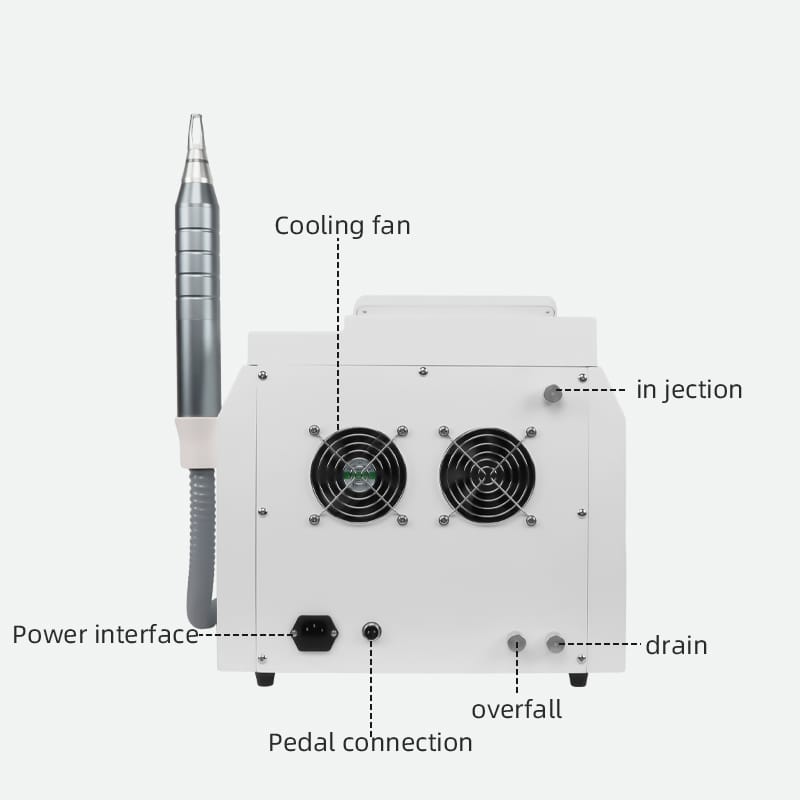
The laser head is cooled by a built‑in water circulation system with an internal water tank. Users must fill the tank with clean water before operation and periodically check the water level to maintain proper cooling performance.
How It Works – Picosecond Laser Technology
The picosecond laser generates light pulses with pulse widths measured in picoseconds (10⁻¹² seconds). This ultra‑short pulse duration produces a photoacoustic (photomechanical) effect rather than relying primarily on thermal mechanisms. When the laser energy is absorbed by target pigment particles (tattoo ink, melanin), the rapid expansion and shockwave fragment the particles into tiny debris that can be naturally eliminated by the body’s lymphatic system.
Typical wavelengths include 532nm (for superficial red, orange, yellow pigments) and 1064nm (for deeper black, blue, green pigments and melasma). The device supports adjustable energy output (0‑2000mJ) and repetition rate (1‑10Hz), allowing operators to tailor treatments based on client skin type, ink color, and pigment depth.
Cooling System – Water-Cooled with Internal Tank
| Feature | Description |
|---|---|
| Cooling Type | Water‑cooled (circulating water) |
| Water Tank | Built‑in internal water tank |
| Maintenance | Before first use, fill the tank with clean water (distilled recommended) until water flows out of the overflow port, then check for leaks. Thereafter, regularly check water level. |
| Function | Removes heat from the laser head to ensure stable operation and extend component life |
Key Design & Technical Features
| Feature | Description |
|---|---|
| Desktop Form Factor | Compact, suitable for countertop placement |
| Customizable Voltage | 110V or 220V (specify when ordering) |
| Customizable Power | 300W or 500W (specify when ordering) |
| Laser Energy | 0 – 2000 mJ (adjustable) |
| Frequency | 1 – 10 Hz (adjustable) |
| Wavelengths | 532nm ± 5nm and 1064nm ± 5nm (dual wavelengths) |
| Pulse Width | Picosecond level (≤ 500 ps) |
| Control Interface | Touchscreen display |
| Cooling System | Water‑cooled with internal water tank (user adds water) |
| Safety Features | Real‑time system monitoring, overheat protection |
Packaging Information
| Parameter | Specification |
|---|---|
| Package Dimensions (W×D×H) | 62 × 46 × 54 cm |
| Package Weight (Gross) | 25 kg |
Note: These are the outer carton dimensions and gross weight. Device net dimensions and weight may vary; please contact us for detailed specifications.
Customization Options
| Option | Available Choices |
|---|---|
| Voltage | 110V / 220V (selectable) |
| Laser Power | 300W / 500W (selectable) |
Technical Parameters
| Parameter | Specification |
|---|---|
| Laser Type | Picosecond Nd:YAG (or equivalent) |
| Wavelengths | 532nm ± 5nm, 1064nm ± 5nm |
| Pulse Width | ≤ 500 ps |
| Energy Range | 0 – 2000 mJ (adjustable) |
| Frequency | 1 – 10 Hz (adjustable) |
| Power Consumption | 300W or 500W (selectable) |
| Voltage | 110V or 220V (selectable) |
| Cooling | Water‑cooled (internal tank, user adds water) |
| Display | Touchscreen |
Common Applications (as intended by device design)
-
Tattoo ink particle fragmentation (professional and amateur tattoos)
-
Pigmented lesion treatments (freckles, lentigines, café‑au‑lait spots, melasma)
-
Skin rejuvenation (using lower energy settings)
Typical Operation Process
-
Client Assessment – Skin type, tattoo/pigment characteristics, medical history, contraindications.
-
Water Tank Filling – Before first use, fill the internal water tank with clean water (distilled recommended) until water flows out of the overflow port. Ensure no leaks. Then close the port.
-
Device Setup – Place on stable counter, connect power (matching the ordered voltage), turn on.
-
Parameter Selection – Set wavelength (532nm or 1064nm), energy (0‑2000mJ), frequency (1‑10Hz) via touchscreen.
-
Preparation – Clean treatment area. Apply protective eyewear to operator and client.
-
Treatment Delivery – Apply handpiece to target area, deliver pulses.
-
Post‑Treatment Care – Provide aftercare instructions (cooling, sunscreen, avoid sun exposure).
-
Maintenance – Periodically check water level and top up as needed.
Safety & Contraindications (Must Read)
✅ Operator Requirements:
-
Professional use only; operator training required
-
Laser‑safe eyewear must be worn (specific to 532nm and 1064nm)
-
Perform test spot before full treatment
-
Verify voltage setting matches local supply before powering on
-
Before each use, ensure water tank has sufficient clean water
❌ Absolute Contraindications (do not treat):
-
Pregnancy or breastfeeding
-
Active skin infections, open wounds, eczema, or dermatitis in treatment area
-
Recent sun exposure (tanned skin) in treatment area
-
Photosensitivity disorders or use of photosensitizing medications
-
Malignant lesions in treatment area
-
Use of isotretinoin (Accutane) within past 6 months
-
Epilepsy or light‑induced conditions
-
Bleeding disorders or anticoagulant use
-
Implantable electronic devices (pacemakers, defibrillators)
-
Keloid or hypertrophic scar tendency
⚠️ Possible temporary effects (typically resolve within days to weeks):
-
Transient erythema (redness), edema (swelling)
-
Purpura (bruising) – especially with 532nm
-
Hypopigmentation or hyperpigmentation (rare, usually temporary)
-
Pinpoint bleeding or crusting (tattoo removal)
⚠️ Important Operational Notes:
-
Always perform a test spot on an inconspicuous area before full treatment
-
Start with lower energy (e.g., 200‑300mJ) and increase based on clinical response
-
Clean and disinfect handpiece between clients
-
Avoid overlapping pulses to minimize thermal injury
-
Never operate the device without adequate water in the tank; this may cause overheating and damage
-
Use distilled or filtered water to prevent mineral buildup
Frequently Asked Questions
Q: What voltage and power options are available?
A: The device can be ordered with 110V or 220V input voltage, and with 300W or 500W laser power. Please specify your requirements when ordering.
Q: Does the device require water cooling? How does it work?
A: Yes, the device has a built‑in water tank. The user must add clean water (distilled recommended) into the tank before use until water flows out of the overflow port. The water circulates internally to cool the laser head. Periodically check the water level and top up as needed.
Q: What type of water should I use?
A: Distilled or demineralized water is strongly recommended to avoid mineral deposits. Tap water may be used temporarily but may cause scaling over time.
Q: How often do I need to change the water?
A: It is recommended to drain and refill the tank every 1‑2 months, or more frequently if the device is used heavily.
Q: What is the advantage of picosecond technology over nanosecond?
A: Picosecond pulses generate a stronger photoacoustic effect, fragmenting pigment particles more efficiently with less surrounding thermal damage.
Q: What energy levels should I use for different applications?
A: Lower energies (100‑400 mJ) for pigmented lesions and fine tattoos; higher energies (500‑2000 mJ) for dense professional tattoos. Perform test spots first.
Share